
July 13, 2026 • 26 min 34 sec
Why Manufactured Housing Is One of Today's Best Commercial Real Estate Investments
Ali with Commercial Real Estate Unfiltered

Watch

Listen
All Episodes
About this episode
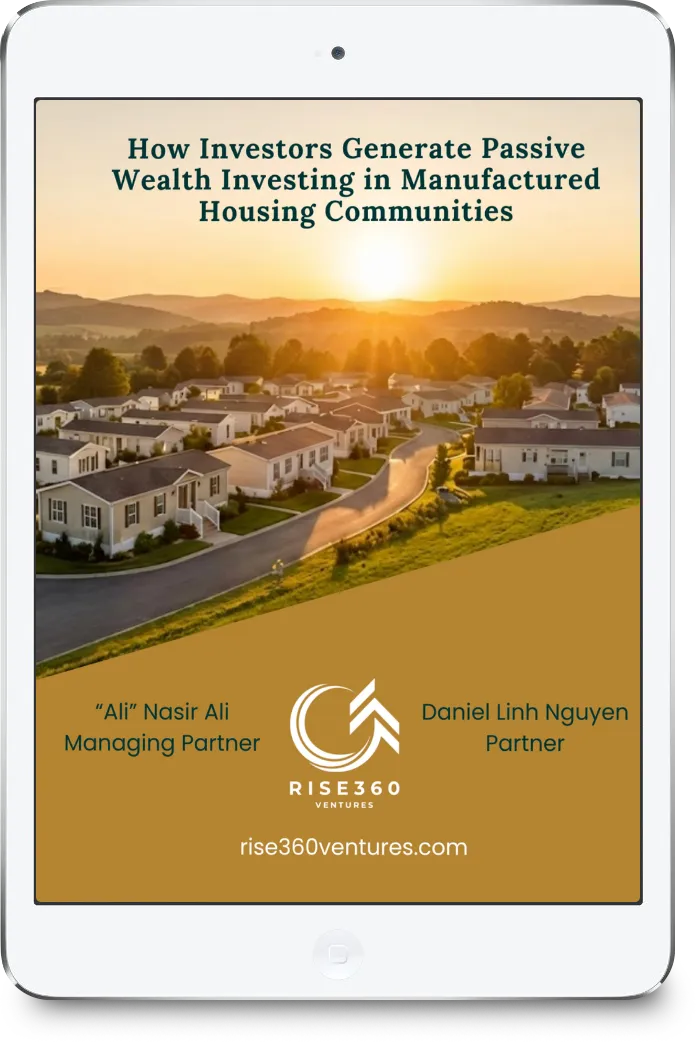
In this episode, Ali joins Commercial Real Estate Unfiltered to trace his family's eight generations in real estate — from the barter economy of Gujarat, India, to running a California mobile home park since July 1981. He explains why manufactured housing has moved from "trailer trash" to a recognized asset class that, by his team's own analysis, outperforms every other CRE category. Ali walks through the vertically integrated model that fills half-empty communities from 50% to 100% occupancy, the "smell test" he runs before buying, the costliest mistake rookies make by mixing personal-property income into valuations, and the passive-income myth. He closes with unfiltered advice for deploying capital in the summer of 2026.
| 0:00 | Cold open — the heavy lift behind "passive" income |
| 0:31 | Welcome to Commercial Real Estate Unfiltered — 45 years, $2B advised |
| 1:01 | Just an average Joe — eight generations in real estate |
| 1:31 | From the barter days in India — the knowledge of wealth |
| 2:30 | Growing up in the park since July 1981 |
| 3:26 | Street smarts and thinking creatively about deals |
| 3:56 | Getting the fundamentals — becoming a manufactured housing appraiser |
| 4:48 | The biggest structural shift in four decades |
| 5:18 | From trailer trash to a recognized asset class |
| 5:47 | The AI exercise — how MHP outshined every other CRE class |
| 6:43 | Institutional money arrives and the stigma fades |
| 7:42 | Affordability, dignity and quality housing |
| 8:38 | Why development was never in the vocabulary — until now |
| 9:36 | The vertically integrated absorption model — 50% to 100% |
| 11:01 | The smell test — what Ali looks at first |
| 12:24 | Reading a property's energy — the body of water example |
| 13:48 | When numbers are all you have — a condemned, absentee-run park |
| 14:18 | Turning distress into stable — the first 90 days |
| 15:28 | The four phases of a value-add turnaround |
| 16:22 | Infill — driving occupancy and asset value |
| 17:18 | The rookie's costliest blind spot — mixing personal property income |
| 19:14 | The passive income myth |
| 20:38 | Ground lease vs. mixed ownership — collecting rent on dirt |
| 22:02 | Arm's-length vertical integration — dealer and financing arms |
| 23:30 | Unfiltered advice for the summer of 2026 |
| 24:30 | REIT, syndication, JV or solo — picking your path |
| 25:26 | Where to connect with Ali and Rise 360 Ventures |
Ali: "Passive" is a word that gets used all too often. There is in fact a heavy lift up front. Of all the CRE asset classes, mobile home park manufactured housing would be the most passive — but it's a heavy lift up front to get there, versus other asset classes where you may have less of a lift up front but then you're lifting throughout the whole cycle.
Host: Welcome back to Commercial Real Estate Unfiltered. I'm excited for our guest today. Ali Nasir is the managing partner of Rise 360 Ventures, with over 45 years of family experience in manufactured housing communities and a track record of advising on over $2 billion in commercial assets globally. He specializes in transforming underperforming communities into high-performing, inflation-resistant assets through deep expertise in operations, valuation and community repositioning.
Host: Ali, thank you so much for being here. Welcome to the show.
Ali: Caleb, thank you so much for having me. I'm excited to be here, and for that intro. I'm just an average Joe, so I hope I can live up to any expectations — but I'm really excited about delivering to the audience with you.
Host: Give us a little background. You've got about 45 years of family history in this. How did that all begin for you?
Ali: I'm so blessed in that sense. When I trace the family history back, we go back at least eight generations in commercial real estate investing.
Ali: It goes back to the barter days in India, through migrations, partitions and wars. What transferred through all of it was the knowledge of wealth — not necessarily the liquidity or the assets, but the knowledge of wealth, and the tenacity, ambition and motivation.
Host: I'd love to hear more about the family's history in India, because I'm half Indian as well. My family's more in the education background. What part of India were they in?
Ali: My father was originally from Gujarat. India historically had a caste system — some families came from academia, others from politics, military, medicine or farming. We were part of the merchant community. We were always merchants, always investors, always in land and in business.
Ali: I've been blessed to be in the mobile home park space since July 9th, 1981. I was just a young man when my father first bought that park. As a typical immigrant family, we were all hands on. I grew up not with football games or prom, but running the park after school and on weekends. It was a great learning experience — not just about the business, but about discipline, family values, contributing to a team.
Host: You literally grew up inside this business. What do you think that street-level upbringing gives you over the typical Wall Street investor wanting to get in?
Ali: I'm notorious for thinking differently. I don't want to frame it as thinking outside the box — I just never knew what the box was to begin with. My father said real estate is a white canvas. If you can think of a creative way to do a deal, we can figure out how to structure it and make it legally compliant. But first, think of the creative, leveraged ways you can get in.
Ali: So I got the street smarts at home, but I wanted to understand the fundamentals too. I went on to become a CRE appraiser, specializing as much as I could in manufactured housing communities. That's where I really understood the fundamentals of underwriting, which I think any investor should understand.
Host: I like that, because there's a need for both the education and the street smarts. We talk about this all the time on the podcast — it's not about transactions, it's a people and relationship business. You've got to show people they can trust you.
Host: What's been one of the biggest structural shifts you've seen in the mobile home park industry over the last four decades?
Ali: In the last 15 years or so, we really became recognized as an industry, as an asset class. Before that, we were trailer trash. We were seen as slumlords — the stigma of the home, the stigma of the business, the lack of support from municipalities because it's not the highest tax-revenue generator for them. All of that pushed us out.
Ali: But then other asset classes, even within CRE, started underperforming compared to us and going through real volatility.
Ali: My team did an exercise recently using AI, comparing all the CRE asset classes on key issues — tenant retention, operating expense ratios, cap rates, NOI, ROI. When you look across the board, it was amazing: the mobile home park asset class outshined every other one, statistically, in every measure by far. I'm biased, of course, but that's what the numbers showed. And I think people started to recognize that.
Ali: Recognition comes with pros and cons. Now you have institutional money, private equity groups and angel investors wanting to get in. The homes have improved, the quality has improved, the stigma is being reduced, and the need for affordable housing has exploded — so municipalities are reluctantly coming on board more and more. There's been a major shift. The challenge is everything's become more expensive and more competitive, and it's harder to find a deal. That's where being aligned with a good operator is key.
Host: Affordability is such a huge issue right now. Are you seeing more development to accommodate that? And I think quality of product speaks to the dignity of a person who wants to feel proud of where they live. I don't know if my kids are going to be able to afford a house when they're ready. I'd love to hear about that tension between providing quality, affordable housing and also making a profit.
Ali: Frankly, development wasn't in our vocabulary in this asset class until the last couple of years. The primary reason is that there were so many communities across the country that were essentially half full — not from a lack of demand, but because the barriers to entry for a resident made it difficult. The upfront cost and the logistics kept them out.
Ali: Those barriers are being addressed now, because people are adopting a model my family has had for 45 years. I'd like to think we were part of the pioneers of it: being vertically integrated, making sure the home is available turnkey in the community, ready to go, with relatively easy financing even for lower credit scores. That lets you take absorption from 50% or half full up to 65%, 85%, and even 100% occupancy across existing communities — before you get into development.
Ali: That absorption has happened so much that people are now flirting with development. You're seeing a little of it in Texas and maybe Florida. It's historically been cost-prohibitive, and I don't know of much happening yet in California, but people are trying to figure it out and expand.
Host: That's super helpful. We need to pay attention to trends — how people are moving from bigger cities to secondary markets — and I'm curious how this asset class follows suit.
Host: What's one of the first things you look at when you're auditing a mobile home park's operational health?
Ali: I'll look at the existing rent roll, the P&L, the financials. But call me old school — I just need to go out to the site. I do what I call the smell test. I walk the property, get a vibe, get a lay of the land — the neighborhood, the city. Are there essentials available? What's the source of income for the residents? Are there medical facilities, banking, grocery stores? In a tertiary market, even those things become questionable. And I'm looking at the property itself — is it a one-star or a five-star?
Host: That's important — the energy around a property, the access to resources. Is it 45 minutes from the nearest grocery store? Things come up you wouldn't even think about.
Ali: I recently did a smell test on a potential acquisition while driving up to one of our existing ones, and I discovered a body of water on site that wasn't really talked about in the listing. Most people would think a lake is cool, but I don't want the risks of a body of water that isn't man-made. A man-made lake you have full control over — it's not deep, and you've made it an amenity. That's very different from a river or a larger body of water you have no control over, which could create liability. Even if the numbers look great, when I see something like that, I'm probably not going forward.
Host: Same thing happened to me before I took on a listing. They wanted an opinion of value, and walking around, one of the buildings was burned — completely condemned — and the one next to it was vacant. At that point I had to go off numbers only, and it was worth half of what they thought. The operator was running it from seven hours away, hadn't been to the property in four or five years, and I don't believe they even had onsite management.
Host: When you walk into an underperforming park, what does it actually take to move it from a distressed property to something operating in a more stabilized way?
Ali: It's a lot of work — that's where the value-add magic is. It isn't for the light-hearted. When we acquire a property, we don't actually do anything for the first 90 days. We sit back and understand it. I won't change the systems, the point of sale — even if it's antiquated — or any of the team members. No drastic changes at the start. First you have to understand what you walked into, because what you were told before you took over is usually very different from reality.
Ali: Phase one is identifying and assessing. Phase two is the initial cleanup — basic things that go a long way in appearance, and cleaning up the operation, streamlining it into what you're already doing with other assets. Phase three is real capex, which may be partly a value-add strategy, but shouldn't be your only value-add play. Then phase four is the actual value-add strategies you execute.
Ali: For example, infill. Most of these parks are half full, so our value-add play is to bring in homes, get them set up, get them financed and get people in. Our income goes up, our asset value increases. It's not overnight.
Host: A lot of people think of real estate as "put money in, get money out." Any good investment has that time of listening and learning what you've got, then figuring out what changes to make.
Host: For a rookie investor, what's one of the most expensive operational blind spots to be aware of?
Ali: It's all in the buying — it's all in the valuing. A mistake a lot of rookies make: some sellers include rental income from the actual homes within their P&L and rent roll. That should be carved out separately, because those homes are personal property — much like your car, they typically depreciate, unlike real property. When you mix those in, you actually become unbankable. Agency lenders now allow maybe 20% of your homes to have a mix on larger deals, but I'd keep that income stream entirely separate. If that income is mixed in and included in the valuation, you're overpaying — substantially.
Host: A lot of people say they're into passive real estate income. What's the biggest misconception about passive income in this asset class?
Ali: The biggest myth is that there isn't a heavy lift anywhere. There is, in fact, a really heavy lift up front. Once you're past that, you can get to a stabilized, relatively passive income — probably the most passive of any asset class. But "passive income" gets used too often. I wonder how truly passive most asset classes are; somebody's always managing something. Of all the CRE asset classes, mobile home park manufactured housing is the most passive — it's just a heavy lift up front, versus other classes where you're lifting throughout the whole cycle. And the lift changes with the market, demand and inventory.
Host: I once worked for someone who was a receiver on a park where some people owned the home on the lot and some leased. Could you talk about how you prefer to do that — just the ground lease, or some mixed parks?
Ali: The conventional model is strictly ground leasing, and it's there for good reason — it's also my preference. It keeps the valuation separate between real property and personal property. And one of the main reasons I'm in this asset class is that I don't want to be a landlord — I don't want the headaches of termites, tenants and toilets. The beauty is you can have 100 or 300 units and not own the walls of a single one. You're collecting rent on dirt. That said, you don't get to that cash flow without the heavy lift of getting homes into a half-full community.
Ali: To operators and investors listening: make sure it's all done at arm's length. You want a vertically integrated infrastructure. For example, community ownership — the real property — sits in one entity. You have asset management and property management. Then you have a dealer arm buying homes wholesale and selling them retail. I wouldn't be in the home dealership business on its own, but I'm in it to create the income stream for my asset. That dealer entity has contracts with the community to place and sell homes. Then, where it's legal — and it can be delicate, so do your own due diligence — you may have a retail financing arm that provides home financing for the resident. Now you've got a turnkey solution: the homes are there, financing is available, they can move in quickly, and you go from 50% occupancy to close to 100% quickly.
Host: That's really good advice.
Host: As we come to a close, what's one piece of unfiltered advice you'd give someone looking to deploy capital into this sector?
Ali: I'm thinking about the economy we're in — right now, the summer of 2026. Things are pretty crazy. We're in stagflation, and the Fed is trapped. You saw this after the dot-com burst, before that in the 70s, and prior to that during the Great Depression, but you haven't seen this level of pressure on the Fed since the dot-com burst. In this environment — and it's true in any environment, but especially now — it's important to accurately identify the value upfront and to have a solid operator and a good operating plan.
Ali: And you don't have to go it alone. You could invest in a REIT and earn less. You could invest in a syndication like Rise 360 and earn more than a REIT. You could go it alone and earn even more, or do a JV. Depending on where you are in your investment life, your timeline and your goals — if you don't want to spend years, even decades, reinventing the wheel yourself — you may want to pick a path in between, where you still get a better return than an institutional investment and can be a little hands-on with the training wheels on. Later, once you feel better, you consider a JV or doing it on your own.
Host: That's really good advice.
Host: Where can people find you and learn how you help investors?
Ali: They can find us online at rise360ventures.com, and Rise 360 Ventures on LinkedIn. We just started a YouTube channel where we're posting these interviews, so they can look us up there too. Happy to connect anytime.
Host: We'll make sure our listeners have all those links. Thank you so much for speaking on a topic I knew little about — I feel educated, and hopefully our listeners will too. Thanks for joining us today.

This website is for informational purposes only and does not constitute an offer to sell, a solicitation to buy, or a recommendation for any securities, nor does it constitute investment advice. All information contained herein is based on sources we believe to be reliable but is not guaranteed as to accuracy or completeness. Investing in securities involves risk, including the risk of loss. Past performance is not indicative of future results. Any forward-looking statements or projections are subject to risks and uncertainties that could cause actual results to differ materially from those anticipated. If you are interested in investing, please request Offering Materials. The securities discussed may not be suitable for all investors, and we encourage you to consult with your financial advisor before making any investment decisions.