
May 14, 2026 • 21 min 43 sec
Why Manufactured Housing Is the Future of Affordable Living
SF Commercial Property Conversations

Watch
All Episodes
About this episode
In this episode, Ali shares how eight generations of real estate wisdom — tracing back to land-based bartering in India — shaped his approach to manufactured housing. He walks through the 1981 collapse that wiped out the family's 120-home Orange County portfolio, the pivot to a KOA that became their first community, and the strategic decision to leave the seasonal hospitality model for stable, passive income. Ali addresses the four-million-unit housing shortage, the flood of institutional capital into the space, macro headwinds including commercial real estate defaults and the unwinding yen carry trade, and why the next 18 months may represent the most compelling buying window he's seen.
| 0:18 | Welcome Ali — eighth generation in commercial real estate, origin story |
| 1:13 | The Iran crisis collapse — 120 homes in Orange County down to 20 |
| 2:11 | Road trip to California and discovering KOAs — the origin of the pivot |
| 2:41 | Buying the first KOA and becoming KOA Joe |
| 3:11 | Seasonal vs. permanent — discovering the mobile home park model |
| 4:09 | The pivot to manufactured housing communities — stability over glamour |
| 5:35 | From trailer trash to the darling asset class — the industry's transformation |
| 6:57 | Gen Z, remote work, and secondary markets driving new demand |
| 7:57 | The 4 million unit housing shortage — manufactured housing as a solution |
| 8:53 | Institutional capital flooding into the space — REITs, private equity, family offices |
| 9:50 | State legislation — the 10% expansion bill and what it means |
| 11:12 | ADUs and manufactured homes as a post-fire rebuilding solution |
| 11:42 | AI integration at Rise 360 Ventures — from admin to every department |
| 13:08 | From family office to fund — the launch of Rise 360 Ventures |
| 14:32 | When is the best time to buy? — nine downturns and the same answer |
| 15:56 | Affordability math — owning a home in the Bay Area for $300–$400K |
| 16:26 | Macro headwinds — commercial real estate defaults, the yen carry trade, stagflation risk |
| 20:13 | The opportunity — why the next 18 months could be the best buying window |
| 20:40 | Where to find Ali — rise360ventures.com and LinkedIn |
Host: Today we have Ali Nasir, and Ali, it's great to have you. I love your story of starting out in a trailer park and building up your real estate portfolio from there. I'd love to hear the backstory of how you got to where you are now.
Ali: Thank you, Bruce. I'm excited to be with you. I'm eighth generation in commercial real estate — going back to the bartering days in India. I've been able to trace our family back to then. My kids will hopefully be the ninth generation in this space.
Ali: I was blessed to have a father who was a serial entrepreneur, passionate about real estate, creating deals all his life — even coming from very modest backgrounds. He built up a nice portfolio of single-family homes during the original Iran War crisis, just prior to it. But during that crisis, everything exploded. We went from 120 homes in Orange County down to about 20 or 30 that he was able to salvage. It all came crashing down like a deck of cards because interest rates went as high as 20.5%.
Host: The Carter years — the famous inflation years.
Ali: That's right.
Ali: Before that collapse, we had relocated from New York to California — a three-month journey over the summer in a brand new station wagon with a trailer, staying at KOAs throughout the country. That's one of the most memorable trips for me, my siblings, and probably my parents. We saw the country. I think that started registering in my father's mind.
Ali: When the collapse happened in the late seventies and early eighties, he was able to salvage enough to put a down payment on a KOA. On July 9th, 1981, he purchased it. The previous owner's name was Joe — and my name is complicated. You can imagine how difficult it was in the Central Valley in the eighties. So I became KOA Joe.
Ali: We grew up operating that park as a family. My father always said, I'm not going to give you fish — I'm going to teach you how to fish. We learned very quickly that this business was great, but seasonal. We needed income all year round, not just in the summer. So we started putting trailers in the back roads and renting them out permanently to construction crews, retirees, and anyone who embraced the concept of smaller living before it became popular.
Ali: That steady revenue stream triggered the realization: we need to get into the mobile home park business — or as we now say, manufactured housing communities. It's less glamorous and possibly a lower rate of return than a cash business like the KOA, but it's more passive, less risk, and provides reliable income. We made that decision and haven't looked back.
Ali: I've personally done other asset classes independently — parking, strip centers — but I'm second generation in manufactured housing by choice, because of everything the industry has developed into.
Host: Manufactured housing seems to be coming to the forefront again right now — partly because it's an affordable solution to housing. Give us a sense of that shift.
Ali: I did a recent presentation titled "From Trailer Trash to the Darling Asset Class." That's exactly what we've seen — experiencing this journey firsthand, going from being called slumlords with all the stigma of trailer parks, to where we are now. The quality and structure of manufactured homes have dramatically improved. I always say: try taking a stick-built home down the freeway at 60 miles an hour and see how it holds up. These homes are transported and still set up beautifully.
Ali: Since the pandemic, hybrid and remote work have made secondary and tertiary markets viable for more people. Gen Z is open to these ideas. Even in Silicon Valley — in Sunnyvale and Santa Clara, right where the big tech firms are — these communities are getting more and more occupied by tech workers. They get it. It's a big change for us.
Ali: The housing shortage is around four million units nationally — and that's on the low end. Some argue it's nearly double. That shortage, combined with reduced stigma and new generations embracing the quality we provide, has put us firmly on the map. We still deal with NIMBY and municipalities that prefer the tax revenue from mid-rises, but the demand for affordable housing is undeniable.
Ali: Every other commercial real estate asset class is saturated. You see REITs, private equity groups, family offices — everyone is coming into our space. And I love it, because ultimately the residents are winning, investors are winning, and communities are winning.
Host: Has the state helped at all? Any state laws helping to develop manufactured homes?
Ali: Theoretically yes — in reality, we'll see. There's a recent state bill that passed allowing communities to expand by 10% of their existing permitted units, bypassing the typical red tape for that increment. It's being tested in some markets now. I hope it works out, because we are a significant part of the solution to that four million unit shortage. We should have full support from government at every level.
Host: There are companies now dropping manufactured ADUs into existing single-family backyards.
Ali: Absolutely — especially in California after the recent fires down south. We saw a lot of people trying to put in manufactured homes as ADUs. It's a viable solution. It's just a matter of getting through the regulatory minutiae to make it happen.
Host: You mentioned you're using AI in your business now. What's going on with that?
Ali: We started with basic admin and support uses, but recently we've acquired a subscription to Claude and my team — marketing, finance, across the fund at Rise 360 Ventures — is extremely excited. We're integrating it into every department now. It's changed how we think about headcount and capacity.
Host: How many people work with you?
Ali: We just launched this fund. The backstory is that I've been involved in our family office for decades — it's now stabilized and looking at possible exit options, so it's essentially on autopilot. In the last six months, my partner Gullin and I have been building Rise 360 Ventures as a fund specifically for this asset class. We went from two of us to twenty people almost overnight. With AI support, I don't know that we need to grow much beyond that.
Host: What's your crystal ball saying about manufactured housing?
Ali: When people ask me when the best time to buy a community is, my answer is the same as when the best time to plant a tree is. The best time was probably 20 years ago. The next best time is today. We've seen at least nine downturns since we bought our first community — the Iran crisis, savings and loan, the dot-com bust, 2008, 2020 — and every time, in a good economy this asset class performs well. In a bad economy, it's been amazing.
Ali: When the economy takes a hit and people come down a notch on the totem pole, we're the last stop — the most affordable option for someone who still wants to own their home, have no shared walls, have a backyard, and make improvements. Where else can you buy a home for $300–$400K in the Bay Area? You just can't.
Ali: There are real macro headwinds worth watching. We're expecting at least half a billion dollars in commercial real estate defaults in the next six to eighteen months. The pretend-and-extend model is nearly done. Those defaults will impact small and regional banks most — and those are the same banks that lend to mobile home parks. The yen carry trade is also unwinding. As Japan's interest rates climb, there's less incentive to buy US bonds, which trickles down to borrowing costs for us as commercial real estate investors.
Ali: I want to be clear — this isn't a political conversation. It's arithmetic. For us as investors, it's about the math. There's a real chance we see conditions worse than 2008 — potentially approaching the stagflation of the late seventies. But the positive is that when the herd is sidelined and everyone's afraid to act, that's when the most compelling opportunities emerge.
Ali: Anytime is a good time to be in this asset class. But the next 18 months may be some of the best times to be acquiring commercial real estate — and manufactured housing communities in particular.
Host: Where can people find you, Ali?
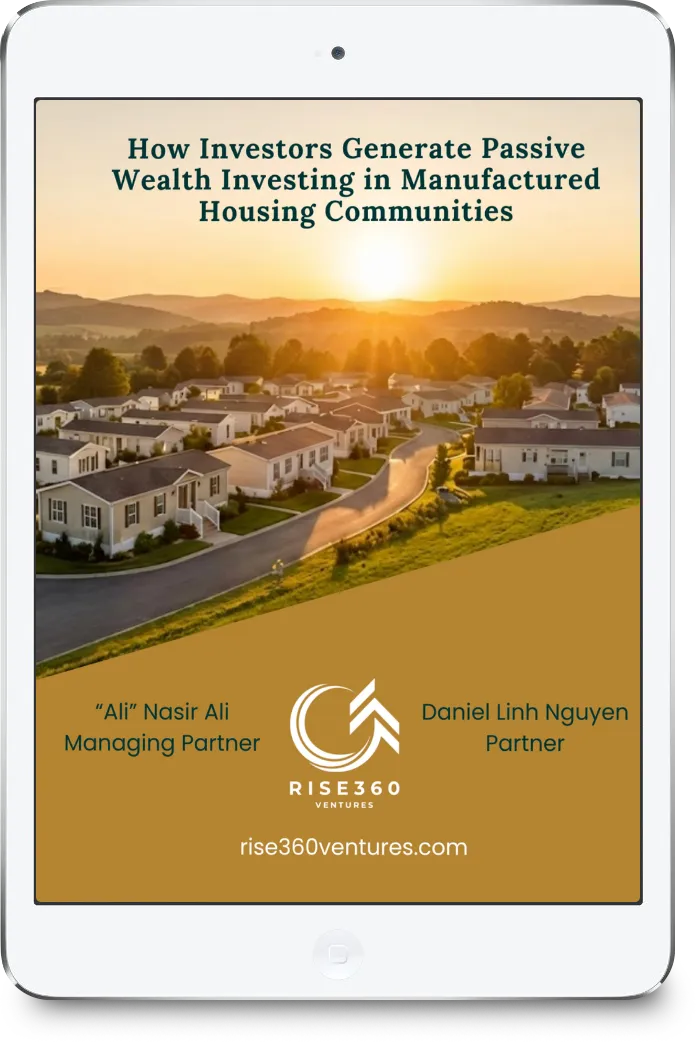
Ali: Go to rise360ventures.com — we have a detailed report covering the industry and the economic landscape we discussed today. You can also find me on LinkedIn.
Host: Thanks, Ali. We really appreciate you sharing your story and your wisdom today.

This website is for informational purposes only and does not constitute an offer to sell, a solicitation to buy, or a recommendation for any securities, nor does it constitute investment advice. All information contained herein is based on sources we believe to be reliable but is not guaranteed as to accuracy or completeness. Investing in securities involves risk, including the risk of loss. Past performance is not indicative of future results. Any forward-looking statements or projections are subject to risks and uncertainties that could cause actual results to differ materially from those anticipated. If you are interested in investing, please request Offering Materials. The securities discussed may not be suitable for all investors, and we encourage you to consult with your financial advisor before making any investment decisions.