
May 07, 2026 • 23 min 29 sec
How to Avoid Costly Real Estate Mistakes (Mobile Home Investing Strategy)
Ali with Real Estate Pros Show

Watch

Listen
All Episodes
About this episode
In this episode, Ali joins the Real Estate Pros Show powered by Investor Fuel to share hard-won wisdom from 45 years in manufactured housing. He breaks down the most overlooked red flag in mobile home park acquisition OMs — personal property income mixed into real property valuations — and explains why it can make a deal unbankable.
Ali covers his buy box, the case for tertiary markets as an underserved opportunity, macroeconomic threats beyond interest rates, and how Rise 360 Ventures scaled through 1031 exchanges. He closes with a clear framework for value-add operators: control the supply chain, or the value won't stick.
| 0:00 | Cold open — the #1 red flag in any mobile home park OM |
| 2:31 | Welcome Ali — Rise 360 Ventures and a 360-degree investment approach |
| 3:26 | Eight generations in real estate — from bartering land in India to mobile home parks |
| 4:23 | Surviving every cycle — Iran crisis, S&L, dot-com, 2008, and COVID |
| 5:57 | Core investment strength — 45 years of operating experience and vertical integration |
| 7:11 | The biggest blind spot in acquisition OMs — personal property income mixed with real property |
| 9:01 | The most underserved niche — tertiary markets, RV parks, and the housing crisis opportunity |
| 11:42 | When the existing playbook stops working — knowing when to pivot |
| 12:40 | Economic threats beyond interest rates — the yen, commercial loan defaults, and weaponized dollars |
| 16:38 | Scaling from $20M to $200M AUM — 1031 exchanges, private capital, and down-cycle timing |
| 19:52 | Golden nugget — control the supply chain or the value-add won't stick |
| 21:44 | Where to find Ali — rise360ventures.com and the free 80-page market report |
Ali: One of the biggest things to watch out for — baked into OMs or the information you first receive about an opportunity — is the income received from the home itself. The mobile home or manufactured home placed in a community is considered personal property. It is not real property. When that income or asset value is included in the valuation, that is a big flaw and a big red flag. People see it and think it looks great. The reason it doesn't work is that you're mixing income from personal property — that mobile home, which depreciates much like a car — with real property income from your dirt. Historically, doing that would make you unbankable.
Host: Welcome back to the Real Estate Pros podcast powered by Investor Fuel. I'm your host, Scott Bursey. Today we have Ali of Rise 360 Ventures — someone who sees the entire landscape in 360-degree fashion and finds opportunity in every corner. Ali, welcome to the show.
Ali: Thank you very much for having me, Scott. I'm so excited to be with you.
Host: For listeners who may not be familiar with your journey — how did your career begin, and where are you now?
Ali: I'm so blessed to have been born into a family that thinks generationally. I'm eighth generation in commercial real estate — traced back to land and bartering in India, where my family comes from. And I'm second generation in the mobile home park business, because my father is one in a billion. Not because of the size of India's population, but because of his entrepreneurial drive and tenacity. I got to grow up as a sponge around a mentor like him. We've seen cycles from the original Iran war crisis in the late seventies and early eighties all the way through to today, and everything in between — the savings and loan crisis, the dot-com bust, 2008, and 2020. Through all of those down cycles, our asset class has proven itself. In a good economy, our business is good. In a bad economy, our business is great.
Host: What is the core investment strength that Rise 360 Ventures relies on above anything else?
Ali: The operating experience — 45 years of being in this business. Everyone has become an expert and entered the asset class, but unless you've been in the trenches, you haven't dealt with the real challenges: private utilities, placing homes on lots, increasing occupancy from the ground up. If you don't understand those nuances and don't have the systems in place to execute, that's where things fall apart. The fact that we have that experience in-house is our key advantage.
Host: What is the single biggest blind spot or risk you actively work to overcome?
Ali: For acquisitions, the biggest thing to watch out for is income from the home itself being included in the OM valuation. That mobile home is personal property — it depreciates like a car. Mixing its income with real property income from your land will, historically, make you unbankable. Agency loans and lenders do allow up to 20% of that income today, but I would still caution anyone acquiring a community to carve it out entirely and treat it separately. Do not include it in your valuation. That right there is a huge piece of advice.
Ali: Internally, what we're working on is strengthening our due diligence process — specifically around inspections. Buying right is almost everything. You don't want to overpay, and you don't want to be surprised by flood zones, earthquake exposure, fire risk, or other issues. We currently outsource a lot of that work, but I'd like to bring more of it in-house.
Host: Outside of the obvious, where is the most underserved niche or market you're currently excited about?
Ali: There is a massive, monumental housing crisis. The stigma around mobile homes, the lower property tax revenue for municipalities compared to multifamily, the NIMBY opposition — these have been the barriers for decades. But as an industry, we're slowly fighting that stigma. I credit associations like MHI, who lobby at the federal level, and all of us working at the state and local levels. The opportunity lies in understanding that we are the solution — and we should be proud of that. We can expand that solution by moving into tertiary markets and smaller sub-markets within secondary markets that REITs, private equity, and family offices have historically avoided. I also think RV parks deserve serious attention — not for their traditional seasonal model, but as a response to the housing crisis, as more people become open to ADUs, tiny homes, and alternative living, especially younger generations.
Ali: I'm honored to have been part of the pioneer class that developed the existing playbooks — my father helped build them, and I developed them alongside him from age 12. But what happens when the playbook is no longer relevant? What happens when the music stops and you need a chair? Can you pivot? Are you entrepreneurial enough to write a new one? That's where people need to really stop and think. A lot of us are following the same playbook, and it won't work indefinitely. At some point, you have to pivot.
Host: Beyond interest rates, what economic shift poses the greatest threat to real estate venture capital right now?
Ali: I'll touch on rates briefly — specifically the yen, which I don't think gets talked about enough. Historically, investors around the world could borrow in yen at essentially zero percent and invest that in US treasury bonds, which made more loans available at our banks at lower rates. Now borrowing in Japan costs more, and their bonds are offering higher returns, which reduces the appetite for US bonds and ultimately tightens our commercial lending environment.
Ali: Beyond that, the commercial real estate loan defaults expected in the next six to 18 months are a real concern. Even the most conservative estimates I've heard start at half a billion dollars. That could mean not just a couple of banks folding as we saw in 2023, but potentially over a hundred small and regional banks impacted — which directly affects our ability to borrow. Add to that the weaponization of the dollar through sanctions and tariffs, and the supply chain risk around rare earth minerals, and the list of threats to deal flow is long. I could talk about this for hours.
Host: If a pro has successfully raised their first fund and is looking to scale from $20M to $200M in AUM, what is the one counterintuitive piece of advice you'd give them?
Ali: I'll speak to how we scaled our family office, because a fund can largely repeat the same model with additional investor capital layered on top. We scaled almost entirely through 1031 exchanges — reinvesting private funds and private capital over and over again for decades. We may have started with smaller assets in smaller markets, but that compounding strategy is what rolled us up to larger positions. That discipline should not be discounted. As for scaling a fund specifically, the next six to 18 months — if we are entering a down cycle — is actually an opportunity. Investors who are liquid and looking to participate will be searching for funds that are prepared and ready to deploy. This is the time to scale.
Host: What golden nugget would you leave with our listeners?
Ali: Keep a close pulse on the day-to-day operations and the process of how you're adding value to your asset. In this space, as a vertically integrated operator, you need to be able to assess and control all of those processes. If you're buying a value-add asset and can't control the supply chain — the process of actually executing that value-add — you're at great risk. It's one thing to find the opportunity. It's another to have the systems and processes in place to deliver on it. I'll also say this: you don't have to be a genius to make money in real estate. The laws of compounding working in your favor will cover for a lot of mistakes. But if you want to reach the higher levels of upside, pay attention to the details.
Host: For listeners who want to follow your journey or collaborate with you — what's the best way to reach you?
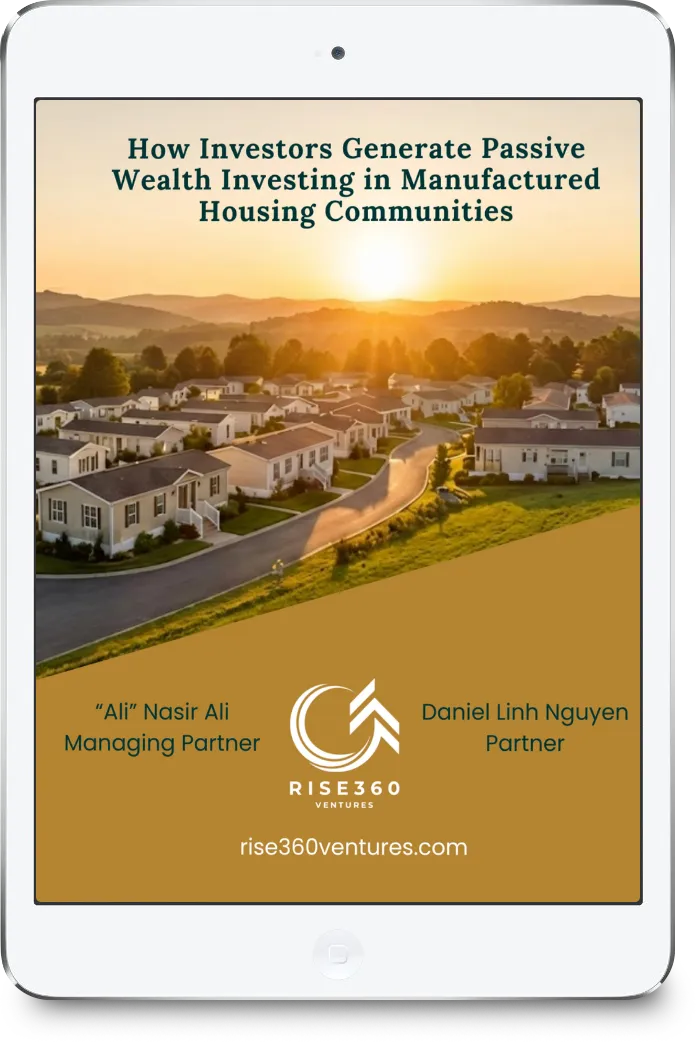
Ali: Reach out through our website — especially if you'd like a free report on current market conditions and where the opportunities lie. Our team has put together a detailed 80-page report. Go to rise360ventures.com, or find me on LinkedIn. Ali, thank you so much for joining us today.
Ali: It's been a real pleasure, Scott. Thank you to your audience as well.

This website is for informational purposes only and does not constitute an offer to sell, a solicitation to buy, or a recommendation for any securities, nor does it constitute investment advice. All information contained herein is based on sources we believe to be reliable but is not guaranteed as to accuracy or completeness. Investing in securities involves risk, including the risk of loss. Past performance is not indicative of future results. Any forward-looking statements or projections are subject to risks and uncertainties that could cause actual results to differ materially from those anticipated. If you are interested in investing, please request Offering Materials. The securities discussed may not be suitable for all investors, and we encourage you to consult with your financial advisor before making any investment decisions.